


YouTube has officially announced significant changes to its Partner Program (YPP), set to take effect on February 1, 2027. According to YouTube’s own announcement, these represent the platform’s first major changes to Partner Program requirements since 2018, and they’ll affect both new creators trying to get monetized and existing partners earning through Shorts.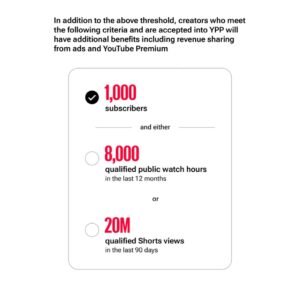
New Entry Requirements for Creators
Starting February 1, 2027, new creators applying to the YouTube Partner Program will need to meet a higher bar than what’s currently required. According to YouTube, the new thresholds will require 1,000 subscribers, combined with either 8,000 qualified public watch hours within the past 365 days, or 20 million qualified Shorts views within the past 90 days.
This represents a substantial increase compared to current requirements, which sit at 4,000 watch hours or 10 million Shorts views. In practical terms, new creators will need to build roughly double the watch-time or Shorts-view volume compared to today’s standard before qualifying for full monetization.
Existing creators already accepted into the Partner Program won’t be affected by this specific change, YouTube has confirmed their status remains unimpacted regardless of these new entry thresholds.
New Requirements for Shorts Revenue Sharing
Separately, YouTube is also introducing a new threshold specifically for Shorts monetization among creators already in the Partner Program. Beginning February 1, 2027, creators will need 10 million qualified Shorts views over the trailing 90-day period to remain eligible for Shorts ad revenue and subscription revenue sharing.
Importantly, falling below this 10 million view threshold doesn’t remove a creator from the Partner Program entirely. According to YouTube, channels that dip below this mark simply pause Shorts-specific revenue sharing while continuing to earn normally from their long-form video content. Once a creator’s Shorts views climb back above 10 million within a 90-day window, Shorts revenue sharing automatically resumes.
Premium Lite Expansion and New Revenue Pools
Alongside these eligibility changes, YouTube is also expanding its Premium Lite subscription tier to all countries where standard YouTube Premium is currently available. Premium Lite offers uninterrupted, offline, and background viewing for most content, positioned as a lower-cost alternative to full Premium.
For creators, this expansion comes with a dedicated revenue-sharing structure. According to YouTube, 60 percent of net Premium Lite subscription revenue will go into a creator revenue pool, which is then distributed based on watch time and views. Within that pool, YouTube has confirmed a 55 percent revenue share for long-form content and 45 percent for Shorts, giving long-form creators a somewhat larger slice of this particular revenue stream. For comparison, standard YouTube Premium subscriptions allocate 30 percent of net revenue to creators, a notably smaller percentage than the Premium Lite pool.
Why YouTube Says It’s Making These Changes
According to YouTube’s official announcement, these updates are intended to reflect how viewers actually watch content today and to help ensure the platform remains a sustainable, long-term growth engine for creators’ businesses. The company also stated it expects to pay creators more overall in 2027 than it did in 2026, framing these changes as part of a broader effort to reward active, consistently engaged creators rather than simply raising barriers for their own sake.
YouTube has also clarified that these specific changes don’t affect eligibility requirements for fan funding, YouTube Creator Partnerships, or YouTube Shopping, all of which remain accessible to smaller creators starting at 500 subscribers, combined with either 3,000 qualified watch hours or 3 million Shorts views over the past 90 days, unchanged from current requirements.
What Creators Need to Do
Existing creators in the Partner Program need to review and accept updated terms within YouTube Studio by January 31, 2027, in order to continue fully monetizing their content without interruption once these changes take effect the following day.
What This Means for Aspiring Creators
For anyone currently considering starting a YouTube channel, these changes suggest that qualifying for full monetization will become meaningfully more difficult starting in 2027 compared to the current requirements. Creators aiming to reach the Partner Program before this threshold increase takes effect may want to factor this February 1, 2027 deadline into their planning, since the current, lower 4,000-hour and 10-million-Shorts-view thresholds remain in place until that date.
Don’t miss a thing! Join our Telegram community for instant updates
For more daily updates, please visit our News Section.
