


Samsung’s Galaxy S26 and Galaxy S26+ launched earlier this year in India and other global markets, both powered by the company’s flagship Exynos 2600 chipset, which Samsung had earlier introduced as the world’s first mobile platform built on a 2nm manufacturing process. Now, with development already confirmed on its successor, new leaked details suggest Samsung may be targeting a significantly higher clock speed for the upcoming Exynos 2700.
Development Already Underway
A Samsung System LSI Business executive recently confirmed to a publication that work on the Exynos 2700 chipset has officially begun, following the successful rollout of the Exynos 2600 across this year’s Galaxy S26 lineup. With that confirmation in place, fresh leaks are now starting to reveal specifics about what performance improvements the next-generation chip might bring.
A Reported 4.2GHz Peak Clock Speed Target
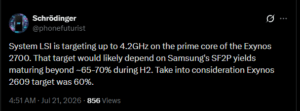
According to tipster Schrödinger (@phonefuturist) on X, Samsung’s System LSI Business, the company’s chip design division, is reportedly targeting a peak clock speed of up to 4.2GHz for the Exynos 2700’s prime core. However, the leaker notes that actually hitting this target would likely depend heavily on manufacturing yield from Samsung Foundry’s SF2P process, specifically requiring yields beyond the 65 to 70 percent range.
It’s worth stressing that Samsung hasn’t officially confirmed any of these details yet, so this specific clock speed target should be treated as an early, unconfirmed leak rather than a finalized specification.
A Notable Jump From Earlier Geekbench Listings
What makes this reported 4.2GHz figure particularly notable is how much higher it is compared to earlier leaked information. The Exynos 2700, carrying model number S5E9975, was previously spotted on the Geekbench benchmarking platform with considerably more modest clock speeds.
That earlier Geekbench listing showed a 10-core architecture, consisting of one Cluster 1 core clocked at 2.30GHz, four Cluster 2 cores clocked at 2.40GHz, one Cluster 3 core clocked at 2.78GHz, and four Cluster 4 cores reaching a peak clock speed of 2.88GHz. If Samsung is indeed now targeting 4.2GHz for the prime core, that would represent a substantial increase over what this earlier benchmark listing suggested, potentially indicating either a later-stage engineering sample with improved performance, or a genuinely ambitious internal target Samsung is still working to achieve.
Expected to Power the Galaxy S27 Series
The Exynos 2700 is widely expected to power at least part of the rumored Galaxy S27 lineup, Samsung’s next generation of flagship smartphones. The chipset is expected to be paired with an Xclipse 970 GPU, and current rumors point toward 12GB of RAM as a likely configuration for devices using this chipset.
On the software side, the Galaxy S27 series is expected to ship with the latest Android 17 update, keeping the lineup current with Google’s newest OS release at the time of its own launch.
What This Could Mean for Galaxy S27 Performance
If Samsung does manage to hit anywhere close to a 4.2GHz peak clock speed for the Exynos 2700’s prime core, it could represent a meaningful performance leap for Galaxy devices using this chipset, particularly for single-core performance in tasks like app launching and everyday responsiveness. That said, given how much manufacturing yield reportedly factors into achieving this target, actual retail chip performance could vary depending on how successfully Samsung Foundry executes its SF2P process at scale.
As with all early chip leaks, these details should be treated as preliminary until Samsung provides official confirmation, with more concrete information expected to surface in the coming months as the Galaxy S27 series moves closer to its anticipated launch.
Don’t miss a thing! Join our Telegram community for instant updates
For more daily updates, please visit our News Section.
